|
|
|
What are Level Transmitters?
|
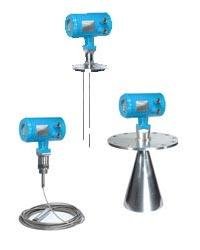 Level transmitters or level transducers are used to measure the level of a liquid or bulk solid material (as well as slurries) within a specified space, and to provide electrical output about these measurements that are proportional to the input level. Level transmitters are designed to measure level based on either a point level or continuous level readings.
Point Level Transmitters
Point level transmitters provide output when a specific level measurement is reached. This output is generally in the form of an audible alarm or an electrical charge to actuate a switch. Multiple point level transmitters can be integrated together to give a stepped version of continuous level.
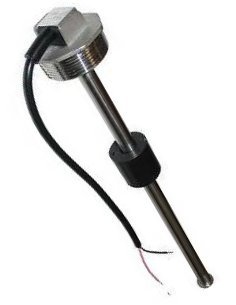
Continuous Level Transmitters
Continuous level transmitters measure level within a specified range and provide
output as a continuous reading of the level. Level transmitters can
operate through a wide range of temperatures, pressures,
vapor gas mixtures, and process conditions. Continuous Level Transmitters can use many different technologies to sense or measure level. Most common are described here.
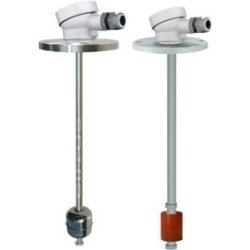
Capacitive Level Transmitters
Capacitive or RF admittance level transmitters
that use a radio frequency technique based on differing dielectric constants.
The impedance detected by the RF changes whenever material approaches the sensing region.
Capacitance level sensors are good for sensing the presence of a wide variety of solids, aqueous and organic liquids, and slurries. The technique is frequently referred to as RF for the radio frequency signals applied to the capacitance circuit. The sensors can be designed to sense material with dielectric constants close to 1 or as high as 90.
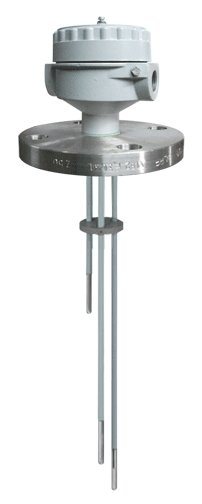
Conductive Level Transmitters
Electrical conductivity level sensors or resistance level sensors use a low-voltage power source applied across separate electrodes. A conductive liquid contacting both probes completes the conductive circuit. Conductive level sensors operate with a low voltage, current-limited power source applied across two separate electrodes. Power supply operation is matched to the conductivity of the liquid, with higher voltage versions designed to operate in less conductive (higher resistance) applications. System design usually includes some type of control, such as pump up / pump down operation. When a conductive liquid contacts both the longest probe (common) and the shorter probe (return) this completes a conductive circuit. Conductive sensors are considered safer because they use low voltages and currents. Conductive level probes are very easy to install and use. With some applications, maintenance can be an issue if buildup insulates the probe. The probes need to continue being conductive or it will stop working properly.
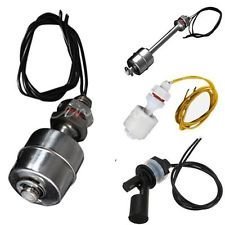
Magnetic Float Level Transmitter
Mechanical or magnetic floats have sealed reed switches in their stems with a permanent magnet installed in the float. When the float rises or falls, the switch inside the stem is activated. Magnetic float level sensors operate by opening or closing of a mechanical switch, either through direct contact with the switch, or magnetic operation of a reed switch. With magnetically actuated float sensors, switching occurs when a magnet imbedded inside a plastic or metal float rises or falls to the actuation level. With a mechanically actuated float, switching occurs as a result of the movement of a float into close proximity of a miniature reed switch.
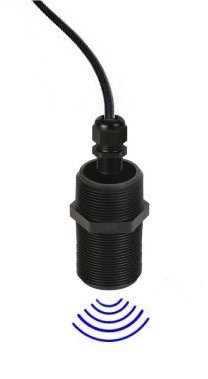 Ultrasonic Level Transmitters
Ultrasonic level transmitters measure the length of time it takes for a reflected sound wave to return to a transducer. Transmitted time is proportional to the measured level.
Ultrasonic level transmitters are used for non-contact level sensing of highly viscous liquids, as well as bulk solids. They are also widely used in water treatment applications for pump control and open channel flow measurement. The sensors emit high frequency signals usually between 20 kHz to 200 kHz. The radiated signal is reflected back to and detected by the emitting transducer. Ultrasonic transmitters are designed for point level control, continuous monitoring or both. Ultrasonic level transmitters used in industrial applications usually provide a standard analog output signal such as 0-5Vdc or 4-20mA or a serial interface for connection to a PC.
|
|
|